Key takeaways
- The edge isn't which model you use — it's how deeply you integrate Claude into a repeatable workflow.
- MCP connectors like Ubersuggest bring live SEO data into Claude, ending the copy-paste tab-switching loop.
- Cowork now syncs across web and mobile, turning social campaigns into one continuous cross-device workspace.
- Use Claude to interpret analytics, not just write posts — close the loop between what you publish and what works.
- Train the whole team via the free Anthropic Academy so prompts and workflows are shared, not siloed.
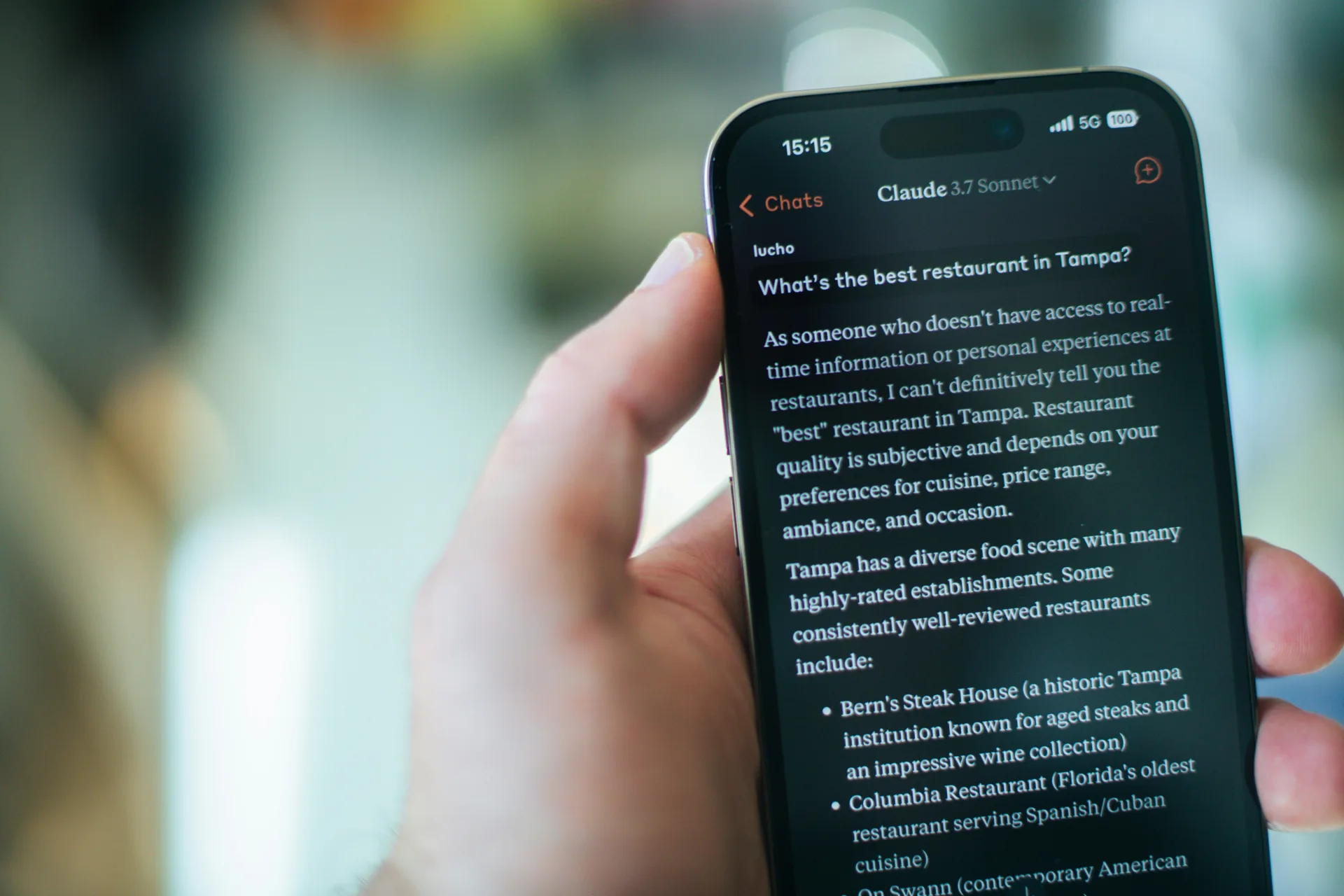
Most marketing teams still treat Claude as a fancy autocomplete: paste a brief, get a caption, repeat. That's leaving 90% of the value on the table. With Sonnet 5 pushing hard into agentic workflows, Cowork now syncing sessions across web and mobile, and connectors piping live data straight into the model, Claude has become less of a writing assistant and more of an operating layer for your entire social media practice.
At Evocative we run social programmes for e-commerce and B2B clients across Brussels and Ibiza, and the shift is tangible. The teams pulling ahead aren't the ones writing better prompts — they're the ones wiring Claude into their actual workflow. Here are five ways to do exactly that.
1. Build a data-driven content engine with SEO connectors
The single biggest productivity killer in social content is context switching. You write in one tab, check keyword demand in another, pull competitor data in a third. The new wave of MCP (Model Context Protocol) connectors — like the Ubersuggest integration that exposes dozens of SEO tools directly inside Claude — collapses that loop.
Instead of copy-pasting keyword volumes and competitor rankings, you ask Claude to fetch them live and turn them into a content angle in the same breath. That means your LinkedIn posts and short-form scripts are grounded in real search intent, not guesswork. The practical win: brief a topic, and Claude validates demand, checks what competitors rank for, and drafts platform-specific variants without you leaving the conversation.
2. Use Cowork to run campaigns across every device
Claude Cowork was desktop-only until Anthropic extended it to web and mobile. For social teams that sounds minor — it isn't. Social work is inherently mobile and fragmented: you spot a trend on your phone, draft on a laptop, approve from a tablet.
With Cowork carrying your sessions and files across devices, a campaign becomes one continuous thread rather than a dozen disconnected chats. A community manager can react to a live moment on mobile, hand the same working session to a strategist on desktop, and keep the full context intact. Treat it as a shared campaign workspace, not a personal chatbot.
3. Turn Claude into an analytics interpreter, not just a writer
Everyone uses Claude to produce content. Far fewer use it to read performance. Export your engagement, reach and conversion data, drop it into Claude, and ask it to identify which formats, hooks and posting times actually moved the needle.
Sonnet 5's stronger reasoning makes this genuinely useful: it can spot that your carousels outperform video on Tuesdays, or that a specific tone drives saves but not clicks. The output is a testable hypothesis for next week's calendar — the loop between what you publish and what you learn finally closes.
- Feed it raw exports from your platform analytics, not summaries.
- Ask for patterns, not praise — request the three underperformers alongside the winners.
- Convert insights into rules Claude can reuse in future briefs.
4. Automate the repetitive with agentic workflows
The story of Claude Code — an unassuming launch that became indispensable to developers within months — is a preview of where marketing is heading. The same agentic capabilities that let Claude execute multi-step coding tasks apply to social ops: repurposing a blog into a week of posts, reformatting one asset into five platform-native sizes, or drafting a full comment-response queue in your brand voice.
Define the workflow once, and let the model run the mechanical steps while your team owns strategy and judgement. That's the real productivity unlock — not faster typing, but removing the low-value work entirely.
5. Upskill your team through Anthropic Academy
None of the above lands if your team can't operate the tools. Anthropic Academy — a free training platform with a catalogue of courses and two certification tiers — is the fastest way to get a marketing team fluent, from prompt fundamentals to building connectors and agentic flows.
We recommend running it as a structured internal sprint rather than optional self-study. A social team that all speaks the same Claude vocabulary shares prompts, templates and workflows far more effectively than a team of scattered individual experimenters.
Where this is actually heading
Claude sits at the top of the current model rankings for a reason, and the pace isn't slowing. But the competitive edge in social media won't come from which model you use — it'll come from how deeply you integrate it into a repeatable system. Connectors for live data, Cowork for continuity, agentic flows for scale, and a trained team to run it all. Start with one of the five, prove the value, then compound.
Sources
- Anthropic dévoile Sonnet 5 et rétablit l’accès à Fable et Mythos — Blog du Modérateur
- Claude Code, l’histoire d’une irrésistible ascension — Blog du Modérateur
- Anthropic étend Claude Cowork au web et mobile — Blog du Modérateur
- Anthropic Academy : comment se former gratuitement à l’IA et à Claude — Blog du Modérateur
- Ubersuggest MCP Connector: Use 37 SEO Tools Inside Claude, Cursor and More — Neil Patel
- Top 20 des modèles d’IA les plus performants en juillet 2026 : le classement complet — Blog du Modérateur